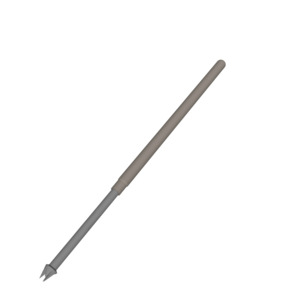

QA Technology 100-PRP4008S-N Probe, 0.100 Center, 0.400 Full Stroke, Triad, Standard SF, 100-40 Series
Our Part #10031241
Condition:New
Mfr Part #100-PRP4008S-N
- Description
- Specifications
- Documents
- High-current probe that carries increased electrical currents for dual level, loaded board testing.
- 0.100 center and 0.400 full stroke probe, part of QA Technology's 100-40 Series.
- Standard Spring Force (SF) made of stainless steel material with a 500,000 cycle life.
- Triad tip style (#08)provides the highest penetrating pressure for reliable testing on flat or domed test pads.
- "-N" No probe lubrication option. Removing lubrication greatly reduces cycle life and should only be used in applications outside of the working temperature range.
- Tube material "P" nickel silver/id precious metal clad improves wear properties and offers < 20 mOhms resistance.
- Working temperature range of -55°C to 120°C with lubrication. SS springs can be used up to 204°C without lubrication.
The 100-PRP4008S-N in QA Technology's 100-40 Series is a high-current probe that carries increased electrical currents for dual level, loaded board testing. With 0.100" center and 0.400" stroke, the standard force stainless steel spring ensures 500,000 cycles of dependable operation. Equipped with a Triad tip (#08), it's used on flat or domed test pads. Internally, the tube maintains < 20 mOhms resistance for accurate measurements. Available without lubrication, denoted by option -N, for use in temperatures outside of the working range. Thanks to QA Technology's patented plunger geometry, you get reliable electrical contact every time. Works from -55°C to 120°C, or up to 204°C for unlubricated stainless steel springs.
Questions and Answers
What is the maximum voltage that QA Technology test probes and sockets can carry?
There is no specific upper voltage limit defined for test probes or socket/termination pins. However, the spacing between probes and the dielectric strength of the probe plate must be evaluated. Probe plate materials that absorb moisture should be avoided. Apply test voltage to the fixture or DUT only after the fixture is engaged and the probes are fully compressed against the DUT. Energizing the probes before they make contact can cause arcing, which may damage or melt the probe tips.
Can QA Probes be used for Hipot testing?
Yes. Hipot testing, short for High Potential testing and also known as a Dielectric Withstanding Voltage (DWV) test, subjects a device to a voltage higher than its normal operating level. The purpose is to confirm that the device’s insulation can withstand this elevated voltage without breaking down, ensuring it provides adequate protection against electrical shock. This method is commonly applied to PCBs, transformers, electric motors, finished appliances, cables, and other wired or wireless assemblies.