
Rohde & Schwarz MXO3-K36 Frequency Response Analysis Option, Software, MXO 3 Series
Our Part #20019695
Mfr Part #MXO3-K36
Rohde & Schwarz MXO3-K36 Frequency Response Analysis Option, Software, MXO 3 Series
Our Part #20019695
Condition:New
Mfr Part #MXO3-K36
Condition:New
- Description
- Specifications
- Documents
Rohde & Schwarz MXO3-K36 - Frequency response analysis option
Key Facts:
- Note: R&S MXO3-B6 is a prerequisite for FRA applications.
- Frequency range 10 mHz to 50 MHz
- Amplitude mode fixed or amplitude profile
- Amplitude level 10 mV to 10 V into high Z; 5 mV to 5 V into 50 Ohms
- Test points 10 points to 500 points per decade
Broad probe portfolio for accurate characterization
Choose the right probes for accurate CLR and PSRR characterization. The low-noise R&S®RT-ZP1X 38 MHz bandwidth 1:1 passive probe is recommended for the MXO 3 series oscilloscope. The probe minimizes attenuation errors and delivers the best SNR, even at low peak-to-peak amplitudes of Vin and Vout. Measurement result table Quickly access comprehensive information about each measured point, including frequency, gain and phase shift with the measurement result table. Save screenshots, table results – or both – to a USB device for reporting and efficient documentation. Calibration and setup FRA calibration can help optimize measurement setups for greater accuracy with passive probes. The calibration data can be saved for future setup for repetitive measurements.
Low-frequency response analysis made easy
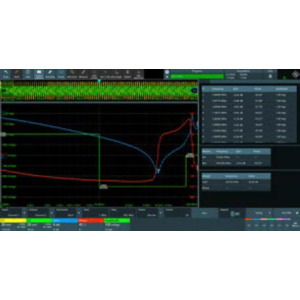
The R&S MXO3-K36 frequency response analysis (FRA) option can get the job done quickly. Easily characterize the frequency response of various electronic devices, including passive filters and amplifier circuits. Precisely measure the control loop response (CLR) and power supply rejection ratio (PSRR) in switch mode power supplies. The FRA option leverages the built-in oscilloscope waveform generator to create stimulus signals from 10 mHz to 100 MHz. By measuring the stimulus signal to output signal ratio for the device under test at each test frequency, the oscilloscope accurately plots logarithmic gain and phase for valuable insights into device behavior.
Amplitude profile for improved SNR
The R&S MXO3-K36 has user-configurable profiles of the amplitude output level from the generator. The signal-to-noise ratio (SNR) is optimized at different frequency ranges, ensuring high-quality CLR and PSRR measurements.